The Only Ambient AI Scribe Built From the Ground Up for Podiatric Medicine
PodScribe listens to your patient conversation in the background and generates complete clinical notes automatically. Not a generic scribe with "podiatry" added — every template, prompt, and output was purpose-built for how podiatrists actually practice.
Start Your Free Trial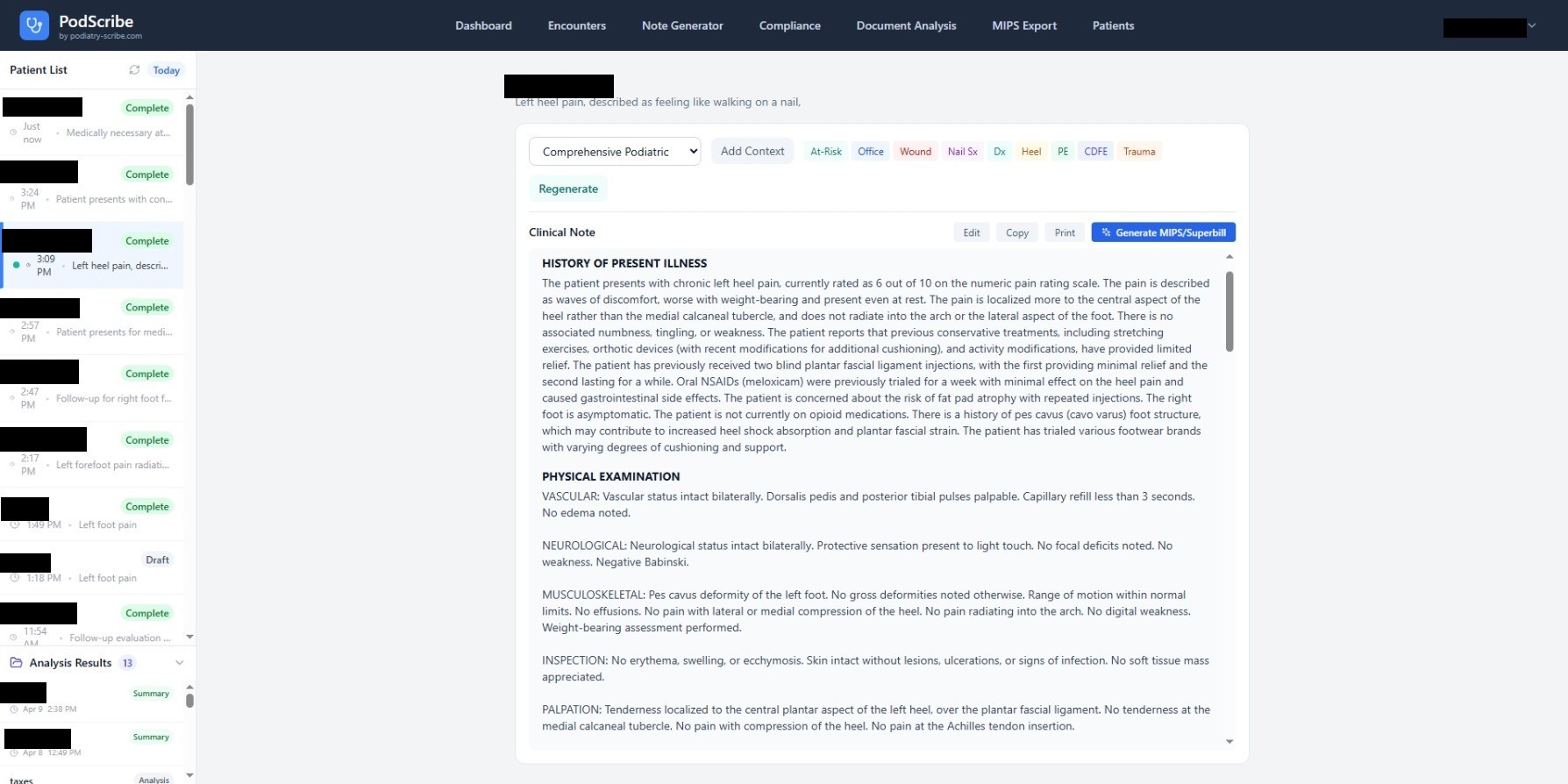
What Sets PodScribe Apart
The ambient AI captures your patient encounter, then generates audit-ready clinical notes in ~30 seconds with podiatry-specific exam sections, proper terminology, CPT codes with laterality, and medical necessity built in.
Context builders that eliminate AI hallucination
AI can listen to your conversation, but it cannot watch you palpate a tendon, test range of motion, or evaluate a wound. Other AI scribes fabricate exam findings from the transcript alone. PodScribe's template builders let you push real, structured exam findings to the AI in one click — so the note reflects what you actually did, not what the AI guessed.
Podiatry-specific physical exam sections
Every note documents vascular (DP/PT pulses, capillary refill), neurological (monofilament, protective sensation), dermatological, and musculoskeletal assessments separately — the way an auditor expects to see them.
Real podiatric terminology
"First MTP joint" not "big toe." "Onychodystrophy" not "abnormal toenail." "Hallux abducto valgus" not "bunion." Notes that reflect how podiatrists actually document.
CPT codes with laterality included
Imaging codes (73630-RT), procedure codes, E/M levels, and modifiers built into the note and ready for billing.
Background generation
Notes generate while you see your next patient. No waiting. Your documentation is ready when you are.
Context template builders with matching AI prompts
Comprehensive, specialty-specific templates paired with AI prompts that know exactly what to do with the data. We did the work so you don't have to.
Enterprise-Grade PHI Protection
Patient identifiers are automatically stripped before AI processing and restored only in the final output. The AI never sees real patient data.
Learn how we protect patient dataQuick Context Template Builders
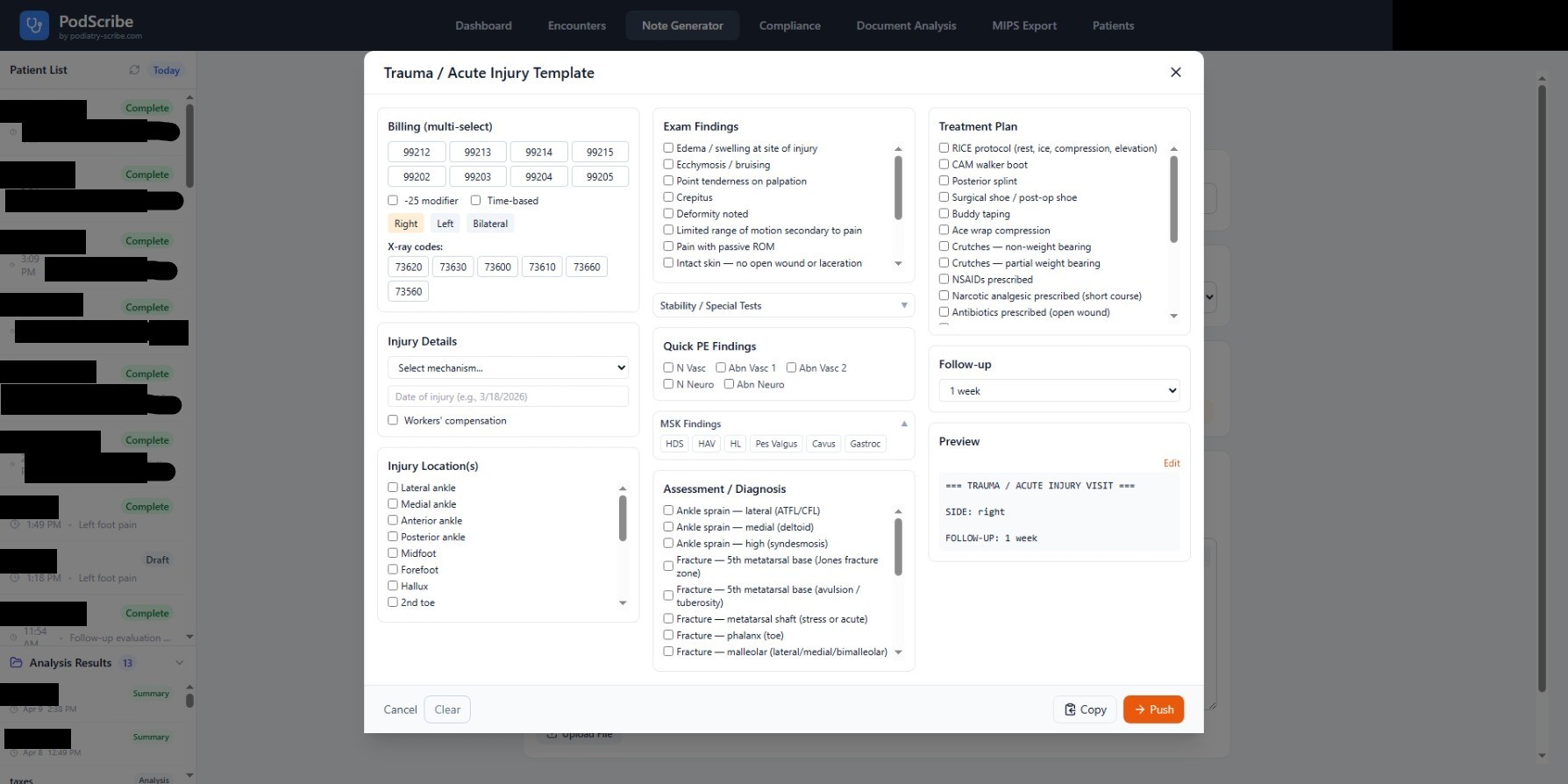
Push structured exam findings, procedures, and billing codes to the AI in one click. Eight pre-built templates covering the most common podiatric encounters.
Office Visit
Injections, nail procedures, I&D, DME, X-ray
At-Risk Foot Care
Medicare DFC with Q modifiers
Wound Care
Measurements, tissue type, debridement
Nail Surgery
Toe selection, phenol, procedure details
Heel Pain
Mechanism, location, imaging
Diagnostics
Imaging, labs, assessment
Trauma
Foot and ankle trauma cases
CDFE
Diabetic foot exam with orthotic RX
We fed the exact same transcript to a leading general-purpose AI scribe and to PodScribe. The difference is what a podiatrist would immediately notice.
Not built for podiatry
The patient presents with a chief complaint of joint pain in the big toe and concerns about a toenail that needs attention. The patient reports experiencing intermittent pain in the big toe joint, which has been previously treated for gout. He describes the discomfort as coming and going, noting that since being at the clinic today, the joint has been "a little bit painful."
The patient has concerns about his toenail appearance, which he attributes to previous trauma that occurred "a long time ago." He recalls that during a previous treatment, "the guy just took that nail off." The patient mentions having neuropathy with "a little diminished feeling" in the area, which may be contributing to his current symptoms.
The patient reports that he has his uric acid levels checked periodically and they are usually under 6, indicating good management of his gout condition. The patient's history includes attending Cornell University where he was on the baseball team, which may have contributed to the previous trauma he mentioned.
Given the symptoms described, the patient's condition appears to be related to his history of gout with possible recurrent episodes affecting the big toe joint, complicated by previous toenail trauma and underlying neuropathy. The intermittent nature of the pain and the patient's history of gout treatment are consistent with gouty arthritis affecting the first metatarsophalangeal joint.
A follow-up plan to address the patient's concerns about the big toe joint pain and toenail condition, as well as to evaluate the current status of his gout management and neuropathy, will be essential in his ongoing care.
Built for podiatry
Pain in the right great toe joint and abnormal right great toenail.
The patient presents with pain localized to the right first metatarsophalangeal (MTP) joint. The pain is described as intermittent and has been previously treated as gout. The patient reports that the pain comes and goes, with recent increased discomfort since relocating to the area. The pain is exacerbated by activity and weight-bearing and impacts ambulation. The patient has a history of gout flares in this joint and has had uric acid levels checked regularly, which are reportedly well-controlled (usually under 6 mg/dL).
The patient also notes a longstanding abnormality of the right great toenail, which is thickened, dystrophic, and has a history of trauma. The toenail does not currently cause significant pain but is lifted from the nail bed and is a potential source of future problems, such as developing a sore underneath with increased walking or closed shoes. The patient recalls a prior nail avulsion in the past. No current drainage, erythema, or overt infection at the nail site.
Ready to See the Difference?
Sign up, record your first encounter, and get a podiatry-specific note in under 60 seconds.
Start Your Free Trial7 days free. No credit card required. Cancel anytime.